Friday, February 14, 2014

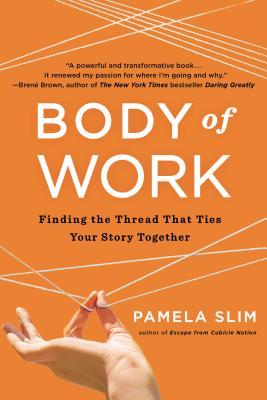
Review of BODY OF WORK by Pamela Slim

Title: Body of Work
Author: Pamela Slim
Publisher: Portfolio/Penguin
What It's About: Body of Work reads like a rare career handbook. Many people have a variety of different jobs in their lifetime, and if you're one of those people, you might wonder how your various career choices actually tie together, if they even tie together at all. Pamela Slim makes the case that we can see our career paths as a cohesive body of work that does indeed have a thread that ties it all together.
Why I Read It: Eight years ago, I knew exactly what my career path was going to be, but soon I discovered that my path wasn't what I thought it should be. When creating a resume last year, I had a hard time trying to see how there was anything significantly in common between the different jobs I've had. This book shows people like me how to find meaning and direction in their body of work.
What I Liked About It: I tend to love reading books that are both career-related and centered on innovation and creativity. This book definitely fits into that niche. Slim's reading is enjoyable as she shares her own personal stories and the stories of people she has worked with in developing a career plan. What I like about this book is that it helps you to find a common thread to your work, allowing you to craft a compelling description of what you've done and how it helps you in whatever it is you're striving to do next. I see this book as one that helps you to develop a narrative of your body of work with a solid throughline that leads you to applying your passions and utilizing your experiences to be successful in your career path. The outlining of the ingredients to your body of work is especially helpful. This is a great book for anyone who wants to find meaning in their body of work and especially for people who have an entrepreneurial spirit. It would also be helpful for recent high school or college graduates.

Review copy provided by Portfolio/Penguin 
Where You Can Buy It: Amazon.com

Photo Credit: Portfolio/Penguin

Thursday, February 13, 2014

The Danger of Feeling Isolated

We are inherently social. Even the most die-hard introvert has the desire to belong to something that is more than just them. It's a longing to be part of a movement. We long to be part of a community of people who share the same values and the same vision of the world.

But what happens when you feel isolated? What happens when you don't feel like you belong anywhere?

Like a tree that needs sunlight and water to grow and thrive, a person who isn't surrounded by people who are investing in them begins to die away inside. No one sees it. Most people are probably completely oblivious to it. But I bet there are a lot of them out there, and I'm afraid for what will happen if no one steps in.

In the Christian world, we say that God loves you and will never leave you. Even when bad situations occur, we're urged to be believe that God still loves us. We're told that we could do nothing to earn God's love and nothing to lose it. 

Many people believe we're not supposed to question it, and that it's unspiritual to question it. God said it, so we should believe it. On the surface of it, I agree we should just trust that God loves us and doesn't ever leave us.

Even if your experience tells you otherwise.

But that's the problem, isn't it? I can't be the only one who has felt at times like God not only got distant, but completely abandoned me. He's nowhere in sight, and I can't bring him back. 

Christianity is interesting because there's so much risk involved in it. And I'm not talking about big risks like the risk of dying if you go on a mission trip to an uncivilized country. Not even the risk that God might actually call you to die for him.

I'm talking about the risk that's inherently built in to the idea that "It is not good for man to be alone." It's the risk involved in God's decision to so often work through people to express his love toward people. God may be perfect, but people are definitely flawed.

If a person's only chance of feeling the love of Jesus is if I express that love toward that person as God's representative, what happens if I say no? What if I feel uncomfortable, so I just neglect to do it? What happens if I hold back God's love from someone?

Because I've watched the church of Jesus fail someone I care about so many times that God's love feels more like hate, it's really easy to start questioning why God chooses to work this way. It's not like God is unaware of the risk. He obviously knows when people are going to fail to do what he intends for them to do. But it's the way he chooses to work, and if God is a perfectly blameless being, where does that leave us?

In the Bible, God called a man named Jonah to go to a corrupt nation of people and show his mercy by telling them they needed to respond with their hearts in adoration of God rather than the raw hatred they had always been expressing. But Jonah failed the first time and ran away. Thankfully, God's love for Ninevah was strong enough that he called Jonah again, but what if Jonah would have ran away again?

It's a horrible existence to live in isolation. To feel like you don't belong. To feel like God himself hates you because his people, who are called to express his heart to a dark and dying world, fail to do that very thing.

It scares me because I probably do it myself every day and don't even think about it. It scares me because I've been able to see firsthand the way a person's soul withers and weathers because of the failure of church.

Author Caleb Breakey recently wrote a book, Called to Stay, about the failures of church in this area and God's desire for burned believers to stay with it and be infiltrators. Why? Because there's too much at risk for a church not to express the loving heart of God to people. People desperately need to know that Jesus loves them and that there is a community of people where they can belong and feel encouraged to press on in the daily struggles of life.

I think there are more people who feel like they're living in a prison of their own isolation more than we realize. It's so easy to be inwardly focused that we never see the people hurting around us. Imagine if people who were called by the name of Jesus joined together and relentlessly pursued the hearts of people the way God desires.

Question: Has there ever been a time when you felt like you didn't belong to something bigger than you? How did you handle it?

Photo Credit: Mariano Kamp via PhotoPin CC

Monday, February 10, 2014

A Journey Back to Writing & Some Thoughts on Identity

As 2013 was coming to a close, I decided that 2014 was going to be the year that I became a writer. The first time that I can remember wanting to be a writer was when I was in junior high. Ironically enough, the movie Scream had come out, and in my angst-driven teenage mind, I thought it was the most brilliant piece of storytelling ever.1


Over the next few years, I took creative writing classes in high school where I wrote stories and screenplays, and I had a lot of fun creating stories in my head and putting them on paper. I knew exactly what I wanted to be when I grew up at that time: a storyteller (through screenwriting, novels, and creative nonfiction). Then something happened that eventually led me to stop pursuing that dream.

I started following Jesus.

Looking back, I realize I bought into a cultural lie that being a storyteller wasn’t a noble calling for a believer, and I stopped trying to be a writer. I would still write from time to time, but my writing was more focused on devotional thought and expounding the Bible. Those things were good, but I missed storytelling.

Within a couple years, I came to believe that my calling was to be a church leader, a professional Christian. A career path that I believed was going to lead me to be a writer and creator for a living was suddenly and voluntarily derailed. I’m not saying I wasn’t genuinely called to that because it is the path I pursued and eventually embraced when I became a youth pastor a few years later. But within 5 years of achieving what I thought at the time was my calling, I walked away from it and into what felt like a vast wilderness where Jesus seems silent.

I don’t think there’s anything more threatening to your personal identity than to achieve your calling and discover that maybe it wasn’t your calling after all. The scariest question in the world is the question of “Who am I?” Without an answer to that question, we’re left desperately searching for the answer, and what we do find is often disappointing.

I’ve recently been reading a book that I feel confident I can say will be my favorite book of 2014. Skye Jethani, in his book Futureville, reveals the Christian cultural assumptions that lead people to believe that Christian ministry is the only noble calling for a believer. I wish this book would have been around 15 years ago, though I probably wouldn’t have gotten it at that time anyway.

Futureville has been a liberating book because Jethani seems to understand culture better than anyone I’ve come across and how an authentic biblical vision of God’s intent for the world impacts the way we live within the culture. Futureville is a game-changing book for understanding the Christian narrative and how it impacts how we live in the world. When we understand God’s end goal for the world, the things we do today have incredible meaning hold the potential seriously impact the world. I seriously love this book because it’s reminding me of things long-forgotten.

Many people define themselves by what they do instead of letting who they are define what they do.

This was the great lie I fell into as a young Christian. If I became a youth pastor, and that became my identity, then I was following a noble calling. Certainly a much nobler calling than being a storyteller.

Of course, when I became a youth pastor, I soon discovered that there’s an implicit hierarchy of noble callings even within the church world, and youth pastor is pretty low on the totem pole. You want to be taken seriously? Then trying being a lead pastor, or a deacon, or a worship leader, or maybe even a children’s minister. Ironically, even as a youth pastor, I couldn’t help being a storyteller, using story as a vehicle to teach the Bible almost every week.

Defining yourself by what you do can get pretty exhausting and it’s an absolutely unhealthy way to live. When you define yourself by what you do, there will always be someone whose identity is better than yours. In an unending cycle of comparison, no one really wins.

I’m a high school English teacher now. It turns out that part of my identity is revealed in my desire to understand students and help them find something bigger than themselves to live for, so maybe being a youth pastor wasn’t so far off from God’s calling for me after all. I get to be creative in my classroom and I get to have really good conversations with students at times about faith and Jesus’ desire for their lives.

Though I think all of us are always on a journey to discovering our core identity, I think I can see that part of who I am has always been revealed in being a writer. I love creating stories and I love communicating through writing, so while I teach writing during the day, I write when I’m not teaching.

Early in the morning. During lunch. After school. At night.

I told myself that 2014 was the year that I would become a writer, and so far, I’m doing exactly that.

I’m doing it because who I am is somehow tied to it.

I’m doing it because in a world where Jesus is making all things new, being a storyteller is a noble calling.

I’m doing it because I have a family who needs me to be who I am and provide for them.

I’m doing it because after fifteen years, the dream hasn’t gone away.

What is one thing you desperately long to do because you feel it reveals something about your core identity?

Photo Credit: Icedsoul Photography .:Teymur Madjderey via PhotoPin CC
Futureville Photo Credit: Thomas Nelson Publishers

1 I wouldn’t call Scream the most brilliant piece of storytelling ever now, though I do think that the original trilogy overall told an interesting story and emotional story even in the midst of blood and horror. Plus, one of the first dates I went on with my wife Lindsey was to the final movie in the original Scream trilogy. She got to see me grow out of my horror movie-obsession phase. I haven’t seen Scre4m. For me, the story was finished in 3. I’ve grown up in my taste for stories, but I still have an appreciation for the way Scream made me believe I could be a storyteller and sparked my love of the trilogy format.
Saturday, February 8, 2014

Weekly Intake - February 8, 2014

Here are a few of the things I enjoyed reading and watching this week on the Internet.


I was a big fan of the TMNT cartoon when I was little, and, thanks to YouTube, my kids have been getting into it. They love it, and I'm getting to relive what it was like to watch it the first time. When you're a parent, it's fun to show your kids what you grew up.

This was big news this past week. In an interview with Emma Watson, J.K. Rowling revealed that, in hindsight, she wishes she would have put Hermione and Harry Potter together in the end. I remember when I first started reading the series, I couldn't understand why the main hero of the story wasn't with the main girl of the story. I think it made sense for Hermione to end up with Ron in the end as the series went on, however. It's interesting to hear an author like Rowling re-imagine something she created.

Jon Acuff is one of the best social media and blogging experts around. One of the things he's really good at doing through his blog is encouraging the readers that he knows tune in to his platform on a regular basis. This post was great because he shares how slow going his success took, encouraging others that reaching their dreams is possible. It just takes time.

It was sad that Philip Seymour Hoffman died. He was a great actor who was in some of the movies I've enjoyed the most. I had just watched him in Catching Fire the week before. His death was tragic because he had everything that most people wish they had, and yet it apparently wasn't enough. Blaine Hogan is the creative director of Willow Creek Church, and he shares his own personal journey with addiction in this short essay.

I've been following Ben Arment for several years since he started the Story Chicago Conference (Sadly, I've never been). He sends out an email to his subscribers, and his email this week was really good. He talks about not avoiding big "asks" just because we think people will say no. He calls that saying no for other people, and we should give people the chance to hear our ideas. If your not on his email list, you should go here and sign up.

I only watched a little bit of the Bill Nye and Ken Ham creation debate, but I learned much more about it from how much it was talked about on Twitter the next day. I personally find myself in the Intelligent Design camp, and this commentary on the debate captures some of the thoughts of what could have been better in the debate. Ham relies on biblical arguments to debate someone who doesn't accept the Bible as any type of authority. I like how Luskin points out actual scientific arguments in favor of design, which leads to the possibility of a Designer. I personally believe that science is all about exploring and making discoveries about the world God created, so science can't be in conflict with faith. I don't personally hold to a young earth view.

Books I'm Reading This Week

What's Your Worldview? by James N. Anderson
This book reads like a choose your own adventure book. Anderson guides readers through a series of questions, and depending on how you answer, you'll be led toward the next question on the path to discovering your worldview. Buy it at Amazon.com

SEO Made Easy by Evan Bailyn
This is a book that uncovers the search engine optimization techniques that will make your website more likely to show up high in Google's search results. The format's great and you'll learn important things to avoid. Buy it on Amazon.com

Futureville by Skye Jethani
This book continues to blow me away. Jethani tears away the false assumptions of American Christianity, some of which I didn't even realize I held. This book makes much of Jesus. Buy it at Amazon.com

The Shadow Throne by Jennifer Nielsen
I'm loving this book so far as it wraps up Jaron's journey. I hope to finish in the next week. Buy it at Amazon.com

Photo Credit: Nathan E Photography via PhotoPin CC

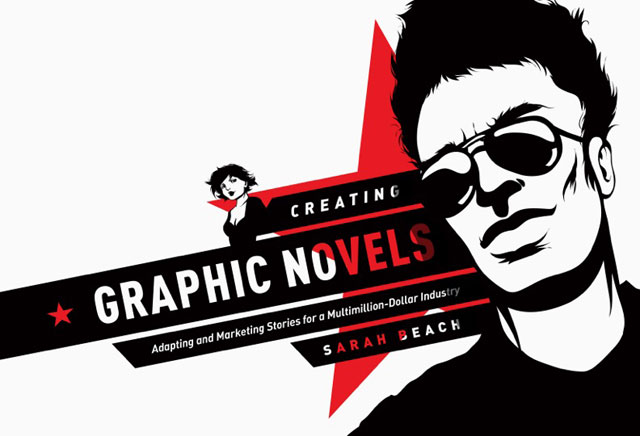
Early Review of CREATING GRAPHIC NOVELS by Sarah Beach

Title: Creating Graphic Novels

Author: Sarah Beach

Publisher: Michael Wiese Productions

What It's About: In Creating Graphic Novels, Sarah Beach introduces screenwriters to the world of graphic novels, outlining the important differences between screenwriting and graphic novel script writing and why graphic novels are an important part of getting a story to spread.

Why I Read It: I love graphic novels and I love screenwriting. I was offered an advance copy of the book from Michael Wiese Productions, so I jumped at the chance to read it.

What I Liked About It: I came to this book knowing that I love the graphic novel format of storytelling. What I loved about this book is the context the author starts from on why a screenwriter would want to adapt their story into a graphic novel. The author starts from the context of building an audience around your story through a graphic novel representation and using this platform to show that your story has the power to engage an audience. The format of the book lends well to teaching the reader about graphic novel creation with the frequent interruptions by a graphical character called "Professor Exposition." Reading the book, a screenwriter will learn how to adapt a story for a graphic novel, as well as learn about the graphic novel industry. It's a fun book and very helpful.

What I Didn't Like About It: It's a unique book that will help screenwriters get into writing for graphic novels. The book is well done, and there really wasn't anything I didn't like about it.

Review copy provided by Michael Wiese Productions

Where You Can Buy It: I got an advance copy of the book, and I'm not sure on the release date. Check out Michael Wiese Productions or Sarah Beach's website for more information.

Friday, February 7, 2014

Flash Fiction Friday: The Journal, Part 1

I always thought it would be fun to blog an ongoing series of episodes of a story. Writing a new chapter in the story each week is interesting because I get to discover along with anyone who reads it what's going on in the story. Here's part one of my first attempt at an episodic story.

The Journal, Part 1

Sara's eyes snapped open. The last thing she remembered was the sky on fire, but the sky above her was black and dotted with stars.

"How can this be?" she said.

She remembered all the people dying. The world ending.

So how was she alive?

The ground beneath her was wet. The grass was soft.

Where was she?

Though her back was screaming in agony, she pushed herself up. She was on a hill overlooking a city. A bright and very much alive city.

How?

The city was destroyed. She knew it.

As she was pushing herself up, she felt something leathery under her right hand.


A book. A journal.

She opened it. Several pages were ripped out, and the ones that were left were blank.

Except one.

On the last page she saw words scribbled in black ink.

Despite what you believe, the world ended.
I saw it all, and I know who really caused it.
But if I told you now, your life would be in much more danger than it already is.
What you see is real, but it's not what you think it is.
Just know that you're not crazy, Sara.

-Jack

Jack? Who is Jack?

Something was wrong. She lived through every moment of the end, but as she looked down at the city below, she saw no evidence of the horrible nightmare she and everyone else went through.

Wait, she thought. The gun shot.

She was shot. She knew it. She passed out from the loss of blood. But the wound in her stomach was gone. Her shirt had been soaked in blood, but now it was untouched.

"I know what I saw," she said. "What's happening?"

Fighting the blurring of her vision, Sara grabbed the journal and ran down the hill toward her home. It shouldn't be there, but somehow she knew it would be.

She ripped open her front door, half-expecting to wake up from this nightmare she found herself in.

Her heart stopped at the sight she saw on couch.

She watched the man she loved the most die at the hands of an evil man, so how could this be?

"Daddy?" she said.

To be continued in Part 2

Photo Credit: karimiaz via PhotoPin CC

Thursday, February 6, 2014

Review of WHAT'S YOUR WORLDVIEW by James N. Anderson

Title: What's Your Worldview?
 
Author: James N. Anderson
 
Publisher: Crossway Books
 
What It's About: What's Your Worldview? reads like a choose your own adventure book. Anderson guides readers through a series of questions, and depending on how you answer, you'll be led toward the next question on the path to discovering your worldview.
 
Why I Read It: I love trying to understand the different worldviews from which people live their lives because what we believe about the world affects how we live in the world. I was also interested in the book because it was being marketed as a choose your own adventure type book.
 
What I Liked About It: I read this book in one day. I love the way it feels like you're taking a journey to discover what you truly believe about the world. I love stories, and the format of the book was a fresh approach. For that alone, I think this book is a great one for anyone to read to discover more about themselves. I love how Anderson makes very careful distinctions between some of the worldviews. There are many theistic worldviews, but only one of them is distinctly Christian. 

If you read this book, especially as a Christian believer, you'll understand more about what you believe and more about what others believe. It's fun to take the journey and answer the questions the opposite of what you believe to see where you end up. This is a unique book, and I would gladly recommend it to anyone.
 
What I Didn't Like About It: This book was so good that there's nothing I didn't like about it.

Review copy provided by Crossway Books through their Beyond the Page reviewer program
 
Where You Can Buy It: Amazon.com