Showing posts with label Writing. Show all posts

Friday, January 24, 2014

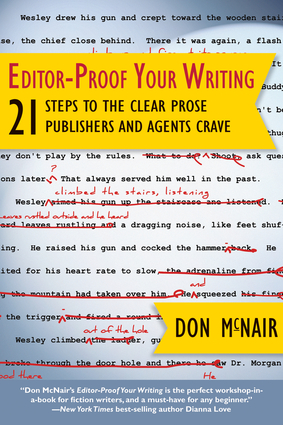
Review of Editor Proof Your Writing by Don McNair


Title: Editor Proof Your Writing

Author: Don McNair

Publisher: Linden Publishing

What It's About: EDITOR PROOF YOUR WRITING is about polishing your writing to a standard that is more likely to get you published. The author walks writers through several chapters on content revision and editing to make writing more crisp and concise.

Why I Read It: I love writing, but I know that I can always improve. This looked like a good book for somebody who wants to be a published author.

What I Liked About It: This book is designed to walk you through editing your work in progress, if you have one. This is a helpful aspect because it puts you into a productive mode with your writing as you're reading the book. The editing chapters were very eye-opening. I didn't realize how many of the writing flaws that McNair outlines show up in my own writing.

What I Didn't Like About It: There's really not anything that I didn't like about the book. It was very helpful, and I would recommend it to other writers.

Review copy provided by the publisher

Where You Can Buy It: Amazon.com

Monday, January 13, 2014

Review of SCREENWRITING BEHIND ENEMY LINES by John Schimmel

In SCREENWRITING BEHIND ENEMY LINES, John Schimmel provides valuable insight into writing a script that studio executives are more likely to read, and he writes as an industry insider. Though there are many similarities between this book and many other screenwriting books, Schimmel's book truly seeks to get readers behind the scenes of the film industry. He seems to hold nothing back as he pulls back the curtain to show the reader what the current state of the industry is and where it has come from.

The bulk of the book covers story structure just as any screenwriting book would. Schimmel applies the ideas to actual films he has worked on, and this is very helpful to see the structure ideas as they're working. There's plenty of homework for the aspiring screenwriter, and going through the book should help any writer find areas where they can improve.

I was looking forward to this book for several months, and I'm glad I got a chance to read it. It's a helpful one, and any aspiring screenwriter would benefit from reading it and applying what is in it.

Review copy provided by Michael Wiese Productions

Where you can buy it: Amazon.com

Saturday, November 16, 2013

Review of CUT TO THE CHASE edited by Linda Venis

CUT TO THE CHASE, edited by Linda Venis, is a valuable resource that takes readers through the process of writing a screenplay for a movie. It's full of helpful information, and the best part about the book is that it's written by writers who teach at UCLA's Extension Writers' Program.

Each chapter is an essay by one of these writers that focuses on one aspect of the screenwriting process. This lends credibility because you're learning from the people who have taught some of the best film writers out there. Learn how to go from concept tp rough draft. Then learn the value of rewriting and making your story truly unforgettable. Learn about the actual mechanics of writing a screenplay and how the film business works.

I've read a lot of books on screenwriting. This one is unique in its approach.

Review copy provided by Gotham Books

Photo Credit: Gotham Books

Review of INSIDE THE ROOM edited by Linda Venis

I've always loved the way some television shows have been able to tell a really great story. Shows like Lost, Smallville, Once Upon a Time, and Supernatural have been some of my favorite storytelling experiences. I've always admired the writers of these shows for their ability to build on a story week after week.

INSIDE THE ROOM, edited by Linda Venis, is a virtual film school in book form for those interested in the process of television writing. The book is broken up into chapters written by writing instructors at the UCLA Extension Writers' Program. The book looks at how the process of television writing works and the specifics behind different types of television shows. It gives aspiring writers the steps to pursue to get their foot in the door as a television writer.

I really enjoy this book for its focus on television writing. I also appreciate the credibility provided by the authors who dedicated their wisdom to it.

Review copy provided by Gotham Books

Photo Credit: Gotham Books

Monday, August 5, 2013

Review of SHAKESPEARE FOR SCREENWRITERS by J.M. Evenson

I've read a lot of books on writing. Most of them are helpful, but not all them are very interesting. SHAKESPEARE FOR SCREENWRITERS by J.M. Evenson is both immensely helpful and interesting. I loved reading the Shakespearian plays when I was in high school, and I remember them being highly suspenseful. Evenson's book reveals why people find Shakespeare to be so compelling. Shakespeare mastered the storytelling techniques we know and love today and put them to great use in his writing.

Evenson's book is broken up into two parts. The first part takes a look at individual plays by Shakespeare and breaks down what made each of them so good. Part two looks deeper into the techniques that Shakespeare used and illustrates how modern storytellers can use those techniques as well. As an added bonus, the author makes many comparisons between scenes in Shakespeare's works and scenes from popular movies that use similar techniques.

SHAKESPEARE FOR SCREENWRITERS is an excellent resource for writers who want to draw on the storytelling wisdom of someone who clearly knew his craft. I greatly recommend this book.

Review copy provided by Michael Wiese Productions

Photo Credit: Michael Wiese Productions

Thursday, May 9, 2013

Review of REWRITE, Second Edition by Paul Chitlik

Second Edition Coming November 2013

REWRITE by Paul Chitlik is a step-by-step guide for screenwriters to take the first draft of their screenplay and greatly improve it. Chitlik states that screenplays often go through several rewrites before a final draft is achieved. He gives some very practical tips on how to make this process effective.

Chitlik covers two types of story structure and what types of stories they fit best - 3-act structure and the mythic structure often associated with Joseph Campbell. He then outlines how to develop your story's characters. I loved the chapter on the emotional relationship in the story. There's a chapter on effectively eliminating pages from your script to tighten the story without losing any of the most vital parts. Each chapter has assignments for you to work on as you're reading so that ideally you're completing a rewrite of a script in the course of reading the book. There are ample examples from well-known movies throughout go illustrate Chitlik's points.

REWRITE is invaluable resource for writers to tighten their scripts and make them better.

Review copy provided by Michael Wiese Productions

Photo Credit: Michael Wiese Productions

Friday, April 5, 2013

Review of CINEMATIC STORYTELLING by Jennifer Van Sijll

In the earliest days of filmmaking filmmakers had to come up with ways to tell a story without the use of dialogue because the ability to sync sound to film was still a thing of the future. This limitation forced filmmakers to be creative in how they conveyed a story on screen, considering such things as camera movements and transitions between scenes. CINEMATIC STORYTELLING by Jennifer Van Sijll looks at 100 ways to tell a story visually using techniques like camera angles, lighting, editing, sound, etc.

While dialogue is an important part of storytelling, filmmaking is obviously a visual medium and the author teaches writers and other filmmakers to keep in mind the conventions that the visual medium naturally encourages. The book includes excerts from scripts and screen shots throughout to help illustrate the techniques.

CINEMATIC STORYTELLING will help screenwriters become better visual communicators and filmmakers as a whole tell better stories.

Review copy provided by Michael Wiese Peoductions

Photo Credit: Michael Wiese Productions

Wednesday, March 27, 2013

Advanced Review of WRITER'S REHAB by D.B. Gilles

COMING OCTOBER 2013

It's a common occurrence for writers to struggle with doing the very thing they feel they were made to do: write. There are a variety of different causes for a writer experiencing writer's block, but how to get past it? There are few things more frustrating than being a writer and not be producing something good that we want people to read. Screenwriter D.B. Gilles offers somewhat of a process of recovery for writers in his upcoming book WRITER'S REHAB. The book is written as a 12-step recovery program for writers "who can't get their acts together."

The 12 steps deal with issues such as perfectionism, being an 80 percent finisher, and coming up with high concept story ideas. The common denominator is that there is usually nothing stopping you from writing more than you are. Sometimes you just need to settle in and do the work. Gilles often encourages seeking therapy throughout the book to deal with serious issues, which wasn't really relevant to me, but I can see why it might be for some people. The book is aimed primarily to screenwriters, but all writers sometimes need a kick in the behind to do what they need to do, which is write.

WRITER'S REHAB is a compact little book that will help a writer explore the often unnecessary reasons for not writing and find useful exercises to get back to it.

Review copy provided by Michael Wiese Productions

Photo Credit: Michael Wiese Productions

Review of. WRITING IRRESISTIBLE KIDLIT by Mary Kole

WRITING IRRESISTIBLE KIDLIT by Mary Kole explores the themes and techniques used that have made young adult stories like Harry Potter and The Hunger Games a success. Kole is a literary agent who knows the world of kidlit and writes with the goal of empowering writers with the skills to write captivating stories to reach a young audience. And, of course, some of the best kidlit works have crossed over to adult audiences as well.

The book of course features all the standard features of a book about writing fiction, such as plot, character, setting, etc. What makes Kole's book unique and especially helpful to writers interested in writing kidlit is her focus on getting into the minds of middle grade and young adult readers and understanding the themes that resonate with them most. There are even tips on starting your career in writing kidlit. Another helpful aspect to the book is Kole's explanations on the differences between middle grade and young adult stories.

WRITING IRRESISTIBLE KIDLIT is a fantastic book for writers who want to break into the literary world carved out by J.K. Rowling, Stephenie Meyer, Suzanne Collins, and many other lesser known authors.

Review copy provided by FW Media

Writing Irresistible Kid Lit
Amazon: amzn.to/12IhB0J
Barnes & Noble: bit.ly/TljX1R
Writer’s Digest: bit.ly/Uopl4b

Photo Credit: FW Media

Thursday, March 21, 2013

Review of PROBLOGGER, 3rd EDITION by Darren Rowse & Chris Garrett

PROBLOGGER by Darren Rowse and Chris Garrett takes all the guesswork out of earning an income from blogging. After sharing their stories of how they became pro bloggers, the authors launch into all the information you need to set up your own blog and begin earning an income from it. This includes the various ways of actually generating income from blogging and how to maximise your earning potential by diversifying your monetization methods.

The book covers the measurements you'll need to pay attention to, how to set up a blogging, choosing a niche and actually writing blog posts, developing a community of devoted readers, and a whole lot more.

Blogging about something you're passionate about and that could impact others gives writers a great opportunity to earn money doing something they love.  I can't recommend this book enough to anyone interested in pro blogging. I'll be putting the things I learned from this book into practice myself.

Review copy provided by Wiley Books

Photo Credit: Wiley Books

Monday, March 18, 2013

Review of APE: AUTHOR, PUBLISHER, ENTREPRENEUR by Guy Kawasaki & Shawn Welch

Rating: 5 out of 5
 
Self-publishing has become increasingly popular as e-readers have made the ability to get your work out there accessible and affordable. But just because you can self-publish a book doesn’t mean you should, or that you know how to, or that your book will be immediately successful. Fortunately, Guy Kawasaki and Shawn Welch have self-published a remarkable book on the subject itself called APE: AUTHOR, PUBLISHER, ENTREPRENEUR.
 
APE like an interesting step-by-step guide to the self-publishing process. After determining if you should even write a book, the authors take you on the journey of being an author and actually writing your book, including helpful advice on financing your book, editing, securing a visually appealing book cover, and formatting for e-readers or for print. Then the authors walk you through the process of actually publishing your book through one of the ebook distributors or directly to readers. Finally, the authors cover how to be an entrepreneur, building a platform for your book and building an audience.
 
The authors include many stories about their own process of self-publishing APE. The book has a ton of helpful advice and should be the go-to guide for anyone who wants to tackle self-publishing a book.
 
Review copy provided by the authors

Review of SHORT FILMS by Patrick Nash

Rating: 5 out of 5

SHORT FILMS: WRITING THE SCREENPLAY by Patrick Nash is a helpful book for anyone interested in screenwriting because it covers all the concepts that are necessary for a writer to write a great screenplay. But it's especially helpful for those interested in short films. Nash refers to short films as a great training ground for aspiring film makers and writers. It makes sense because if you want to write a great screenplay, a great way to know if you would be any good at it is to complete a short screenplay first. 

Nash's book walks you through the process of doing that. After a short history lesson on filmmaking and the reasons for embracing short films, Nash gets into the core of the book which is telling a great story through the short film medium. From coming up with a story idea to developing your story into beginning, middle, and end, to structuring your story into a short screenplay, the chapters in SHORT FILMS are relatively short and to the point. One of the most important chapters in the book, I think, is the chapter on screenplay formatting. This takes the guesswork out of formatting in a way that professionals do. 

SHORT FILMS is an almost pocket size guide and easy to read in a short time. I've read  a lot of books on screenwriting, and while a lot of this stuff I've come across before, this book is a helpful addition.

Review copy provided by OldCastle Books

Photo Credit: OldCastle Books

Thursday, October 11, 2012

Early Review of FORENSIC SPEAK by Jennifer Dornbrush

Who the book is for: Fiction Writers
Rating: 5 out of 5

FORENSIC SPEAK: HOW TO WRITE REALISTIC CRIME DRAMAS by Jennifer Dornbush is a great resource for any fiction writer. Realistic crime scene investigation in a novel or screenplay requires an accurate use of the terms and methods used in forensic science, but if you haven’t went to school to study it, then you have to research it for yourself, which can take up a lot of time that you could be spending writing. Dornbush has compiled all the information you could need to make your crime stories realistic.

After an introduction about growing up the daughter of medical examiner and becoming interested in forensic science and how it fits into fiction, Dornbush takes us into the world of forensic science. From crime scene investigation to toxicology to fingerprints to DNA, guns, and courtroom procedures, FORENSIC SPEAK gives writers a concise and easy-to-understand guide to making their stories more believable. The book covers important terms and describes how they’re used. The book gives examples from many films and includes exercises as well.

FORENSIC SPEAK reduces the amount of research writers have to undertake in order to craft realistic crime stories. It’s a great resource, and it’s definitely one I’ve been looking for awhile. It comes out February 2012 from Michael Wiese Productions.

I received this book for free for review from Michael Wiese Productions, and the opinions contained in this review are completely my own

Available February 2013

Thursday, October 4, 2012

My Review of @WriMo: A 30 Day Survival Guide for Writers by Kevin Kaiser

Rating: 5 out of 5

“[T]he creative process has nothing to do with making something out of nothing and everything to do with discovery. Creating is discovery. Creating is doing. And that, friends, means action.” –Kevin Kaiser

Every year in November thousands of writers commit to writing a 50,000 word novel in 30 days as part of the National Novel Writing Month (NaNoWriMo). It’s a grueling endeavor, and few make it to the end. But for those who do, it’s the opportunity to create something they can be proud of simply because they finished. To be a writer, you must write.

Kevin Kaiser is an important and resonating voice in the literary world. He’s the brand manager of New York Times Best-selling Author Ted Dekker, as well as a creative force all on his own. He’s committed to writers, and this commit shows in his willingness to be open to sharing his wisdom through his blog StorySellerPro. As a part of his commitment to writers and rooted in his belief in NaNoWriMo, Kaiser has written @WriMo: A 30 Day Survival Guide for Writers, a thirty-day “kick in the moneymaker” designed to be a source of inspiration to help the writers participating in NaNoWriMo to make it to the end.

I love Kaiser’s voice and expertise, and this book is full of practical wisdom on what it takes to stay focused on finishing your novel during NaNoWriMo. It’s not so much a book about the mechanics of how to craft a great story. Instead, the short blog-post-length chapters for each day tap into the motivations of the writer and expose the self-made hindrances many writers face during the crafting of their story.

Kaiser believes that writers can’t wait on inspiration. They must writer whether inspiration comes or not. Success comes with hard work and commitment. He’s gut honest about the discouragement writers will face and tells them to keep at it anyway. Don’t let anything stand in the way. “Bring it on,” Kaiser says. I loved his inclusion of Emma Coats’ 22 Story Rules. Coats was a former Pixar storyboard artist and shared these story rules on Twitter. My favorite chapter was “The Place,” which was an inspiring original short story by Kaiser.

For those participating in NaNoWriMo, @WriMo is the perfect guide to awaken your motivation each day in November. All the proceeds raised from the book will donated to support the future of NaNoWriMo. Check out Kevin Kaiser at StorySellerPro and click the link below to find the book on Amazon.

Review copy provided by the author

Thursday, September 20, 2012

Review of WIRED FOR STORY by Lisa Cron

Who the Book is For: Writers, Storytellers
Rating: 5 out of 5

According to WIRED FOR STORY by Lisa Cron, brain science has discovered that human beings thrive on storytelling. Stories help our brains to become prepared for possible situations that may arise in our lives in the future. Stories act as a type of practice for our brains.

WIRED FOR STORY looks at the various ways the human brain is impacted by story and walks writers through the ways to apply these important insights to crafting stories that will keep readers hooked from the very beginning. Each chapter begins with a cognitive secret and then applies this to writing a great story. I especially appreciated the chapter on theme. Cron argues that every story has a point that it is trying to make, and she gives advice on how to shape the story's meaning and communicating it in a way that isn't preachy.

WIRED FOR STORY has a lot of the same advice you'll find from almost any fiction writing book. However, it looks at storytelling from a more fundamental perspective of how our brains are designed to affected by story.

I received this book for free for review from Ten Speed Press, and the opinions contained in this review are completely my own

Friday, August 24, 2012

Review of LET'S WRITE A SHORT STORY! by Joe Bunting


Who the Book is For: Fiction Writers
Rating: 5 out of 5

I love writing stories, and I’ve always wanted to write and publish a novel, but a novel is a long and strenuous journey. Though I’ve written 60,000 words of a novel I started a couple years ago, I just can’t find or justify the time to finish it at this point in my life. But another thing I’ve always enjoyed doing is writing short stories. I’ve written several, but I’ve never really seen them as anything more than for my own benefit. A few people have read my stories and enjoyed them, but I’ve never thought I could get one published.

Joe Bunting of The Write Practice blog just released a new ebook called LET’S WRITE A SHORT STORY! It’s a concise and practical guide to writing short stories and why a fiction writer should spend time focusing specifically on writing short stories. Bunting does a great service to writers in providing the encouragement and direction to write stories and going through the emotional risk of submitting them for publication. If you don’t know how to submit a short story for publication, Bunting’s book will guide you through it. Bunting shows that writing short stories is great practice for larger fictional works, and it’s a source of inspiration to actually complete a story.

LET’S WRITE A SHORT STORY! leaves fiction writers with no excuses and every reason why they should make the goal of writing a short story and submitting it for publication to a literary magazine in the next month. In fact, that’s exactly what Bunting is calling readers to do. Check out the book’s website at http://www.letswriteashortstory.com>letswriteashortstory.com

Review copy provided by the author

Tuesday, June 12, 2012

My Review of WRITE-A-THON by Rochelle Melander


Photo Credit: Writer's Digest

Who the book is for: Writers
Rating: 4 out of 5

Can you write a novel in twenty-six days? Rochelle Melander, the author of WRITE-A-THON, believes that you can. WRITE-A-THON is a guide to preparing for and executing the writing of a novel or a nonfiction book in marathon style in twenty-six days.

The book is divided up into three sections. The first section is Training. It’s all about getting prepared to write a book. There’s some great stuff in this section, from determining writing strengths, to outlining a novel or non-fiction book. The second section is the actual write-a-thon, and this section is mainly about encouraging the writer in the midst of the writing marathon. The final section is Recovery, and it’s about revising the book you’ve just written during your write-a-thon.

What’s great about this book is that it’s written in short digestible chapters that include practical writing tips for fiction and non-fiction writers alike. Not everyone has the time to set aside twenty-six days in order to write a book, but the information contained in this book is still helpful even if you don’t plan on doing your own write-a-thon.

I received this book for free for review from Writer’s Digest Books, and the opinions contained in this review are completely my own

Monday, May 14, 2012

Review of CRAFTING NOVELS & SHORT STORIES from Writer's Digest Books


Photo Credit: Writer's Digest Books

Stories help us make sense of the world, and it’s been said that whoever tells the best stories shapes the future. The best storytellers are always learning more about their craft, learning from the best writers and instructors the world has to offer. Writer’s Digest Books has compiled an indispensable new resource on creating stories that features essays from some of the best minds in writing. The book is called CRAFTING NOVELS AND SHORT STORIES: THE COMPLETE GUIDE TO WRITING GREAT FICTION.

Writer’s Digest Books has been producing quality writing instruction resources for a long time, but this one is really great because it packs so much information on the core elements of writing fiction all in one book. Most writers of fiction want to be published. They want their stories read by people and want to impact their readers. The idea behind this book is to create stories that agents, editors, and readers want to read and can’t put down. I personally try to read everything on the writing craft from James Scott Bell and Steven James, who are both featured in the book, and made the book an immediate draw for me.

All the important elements of fiction are covered in the book. From characters, to dialogue, to plot, to revision, this book will walk you how to write better and more impactful stories. I especially enjoyed the “Focused on the Writing Life” sections which covers things such as making time to write, beating writer’s block, productivity, and research.

CRAFING NOVELS AND SHORT STORIES is a great resource for fiction writers that you’ll want to go to over and over again. If you aspire to write great fiction, the essays in this book will help.

I received this book for free for review from Writer’s Digest Books, and the opinions contained in this review are completely my own

Wednesday, May 9, 2012

My Review of COFFEE BREAK SCREENWRITER by Pilar Alessandra

COFFEE BREAK SCREENWRITER by Pilar Alessandra is a really helpful book for anyone who has ever wanted to write a screenplay but find it difficult to make time to do so. I’ve wanted to be a writer since I was in junior high, and I’m always trying to learn how to be a better writer and tell better stories.

Screenwriting is a great opportunity to learn how to write stories that people can visualize, and it’s a condensed story structure where every element, every word, must serve the overall story. Alessandra gives writers several small chunks of instruction on how to write a screenplay, and the book is especially great because she walks writers through writing a screenplay from beginning to end.

From how to come up with a compelling story idea, to structuring and outlining its elements, to developing characters and writing dialogue, to writing the first draft and revising to a final draft, COFFEE BREAK SCREENWRITER reads like a workbook that guides a writer through the complete process of producing a winning screenplay.

I came to the book knowing a little about screenwriting and having written some scenes before, but the book added so much to my knowledge base on screenwriting. It’s a great book for beginning screenwriters, and it really is a great resource for finding the time to write a screenplay in ten-minute chunks of time. Alessandra’s discussion of scene intention really opened my eyes on how to craft scenes and what I need to accomplish in a scene.

COFFEE BREAK SCREENWRITER is a book that I’m going to keep close as I’m crafting a story because it will be a really helpful reminder of exactly what things I need to think through to structure a great story. If you’ve ever wanted to write a screenplay, this is a great resource on how to do it.

I received this book for free for review from Michael Wiese Productions

Thursday, May 3, 2012

For Writers and Screenwriters: Review of THE LAST WORD by Tom Lazarus

Great writing is rewriting. Most writers hear this all the time, but they may not be aware of some practical tips to put into place to do rewriting well. Tom Lazarus is a screenwriting instructor at UCLA and the writer of the movie Stigmata. Lazarus introduces over a hundred practical and immediately helpful tips for rewriting in his upcoming book THE LAST WORD: DEFINITIVE ANSWERS TO ALL YOUR SCREENWRITING QUESTIONS. I enjoy all types of writing, from nonfiction to fiction to visual storytelling such as screenwriting, so this book was a helpful and enjoyable resource for me as a writer. Though it’s targeted at screenwriting specifically, if you’re not a screenwriter, you can still learn a lot about refining stories you’re writing from Lazarus’ book.

Reading the book fells like the experience of having a writing coach in your ear, giving you helpful tips to creating your best work, and Lazarus does it in a way that communicates authority and a clear know-how for what he does. The book is structured into several short easy-to-read chapters where Lazarus shares some notes that he’s written on different screenplays that he’s read and consulted on. It was great to journey into the mind of story consultant through the book and learn from his wisdom.

Throughout the book, Lazarus continually purports that our best writing is done by rewriting and adapting and improving. It makes me think of the visual of creating a piece of clay, then shaping the clay into something profound. We have to write something complete first, then we can shape it into something beautiful, emotionally-stirring, and thought-provoking.

Some of the areas that come to mind as helpful are tips on description of what the camera sees, avoiding backstory and creating a forward-momentum plotline, avoiding using language that can’t be filmed and tears readers out of the story.

THE LAST WORD was a really enjoyable book and a valuable resource for any storyteller, but especially for screenwriters. Look for the book to release in a few months from Michael Wiese Productions.

I received this book for free for review from Michael Wiese Productions, and the opinions contained in this review are completely my own