Showing posts with label Theodicy. Show all posts

Tuesday, August 6, 2013

Review of LOVE, FREEDOM, AND EVIL by Thaddeus Williams

In LOVE, FREEDOM, AND EVIL, Thaddeus J Williams tackles the problem of evil and specifically explores the validity of the free will defense. Does authentic love require free will? Through philosophical arguments and biblical exploration, Williams exposes many of the weaknesses of the free will defense for the problem of evil. Williams espouses the compatibilistic view of human free will. I come to this book as one who holds to libertarian free will, but I must admit that Williams’ arguments seem solid and give me much to think about.

Compatibilistic free will on the surface does make sense. People are responsible for their actions if what they are doing is in accord with what they want to do. They’re not forced to do something they don’t want to do. Williams argues for this pretty convincingly. On the surface, obviously people do what they most desire. But there’s obviously times where there is some deliberation between competing desires. I don’t think compatibilistic free will can deal with this deliberation or explain why someone chooses one thing one time and something else another time if their nature determines their desires.

I actually enjoyed this book a lot because it forces me to think hard about what I believe. It also raises a lot of questions in my mind about what determines what people do. Because responsibility seems to require people doing the thing that they most desire, I have questions about desires being a coercive force that bends a person’s will toward it.

While I still hold to a libertarian view of free will, I really enjoyed the writer’s style and how he approached the issues. He handles opposing views with humility. I would recommend this book as a catalyst for thinking deeper about the issues of human freedom and divine sovereignty.

Review copy provided by Rodopi

Photo Credit: Rodopi

Tuesday, June 4, 2013

Review of EVIL AND THE JUSTICE OF GOD by N.T. Wright

The problem of evil is one that I, like almost everyone else in the world, have wrestled with ever since becoming a Christian. In EVIL AND THE JUSTICE OF GOD, thelogian N.T. Wright wrestles with this problem head-on by focusing on a God who does respond to evil. He examines the Bible to reveal the ways that God has fought against evil throughout history.

As the title of the book suggests, Wright focuses much of this book on the epitome of God's defeat over evil in the crucifixion and resurrection of Christ. Wright paints a picture of God's ultimate defeat and removal of evil in the new heavens and the new earth. He suggests that we don't live just waiting for this moment, but living lives of justice toward others in light of the world God is bringing about. In this way, we act as agents of God in the fight against evil.

No one has ever definitively solved the problem of evil, and this book won't do it either, but it does present God as one who is against evil and doing something in response to it.

Review copy provided by InterVarsity Press

Photo Credit: InterVarsity Press

Saturday, March 23, 2013

Review of GOD AND EVIL edited by Chad Meister and James K. Dew Jr.

The reality of evil and suffering in a world is a problem that everyone struggles with at some point, especially when it comes to believing in the existence of a good God who created the world we live in. If a good God created the world, why all this evil? GOD AND EVIL is a new book from InterVarsity Press edited by Chad Meister and James K. Dew Jr. The book is a collection of essays by scholars and Christian thinkers wrestling with the many different issues involved in the problem of evil. There's some interesting essays in this book, including possible reasons why God might allow evil, an essay on God's hiddenness, original sin and its origin, evil from the perspective of other religions, and of course hell. There are even essays on evolution and intelligent design.

I especially appreciate Bruce Little's contribution on gratuitous evil, Paul Copan's contributions on original sin, and William Craig's chapter on the doctrine of hell.

The only issue I had with the book, which could be a strength or a weakness to the book, is the differing and sometimes contradictory viewpoints taken up. For example, Craig argues for a particularist approach to hell which is followed by an essay by Kyle Blanchette and Jerry L. Walls arguing for more of a Rob Bell-like inclusivist approach. Someone reading this book hoping to come away with some solid answers may find themselves more frustrated by the end. Still, it was interesting to see some of these viewpoints side by side and would recommend it to someone who has already had some experience wrestling through the issues presented.

Review copy provided by InterVarsity Press

Photo Credit: InterVarsity Press

Wednesday, February 20, 2013

Review of IF GOD IS GOOD by Randy Alcorn

Rating: 4 out of 5

I think few people are free from the struggle of reconciling a good and loving God with the existence of evil and suffering. IF GOD IS GOOD by Randy Alcorn tackles many of the questions brought about by the struggle. Alcorn has been one of my favorite authors, so I was very interested in reading his take on what is one of the thorniest subjects in the world.

The book is good in that it reveals the utter failure of the non-theist to adequately solve the problem of evil. Alcorn also shows how God can and does bring good out of the suffering that people undergo. He delves into how God utilizes suffering specifically in the process of maturing a believer in Christ. He also brilliantly shows God's two eternal solutions to the problem of evil in heaven or hell. Hell makes sense in light of the problem of evil if Christianity is true.

While I appreciate Alcorn as an author, I didn't find his arguments for compatibilist free will convincing. He argues it well, but I think one of the implications of compatibilism is that God can't genuinely offer salvation to all if he only enables a select few to even be able to respond to that offer. I also struggle with embracing the greater good theodicy that states that God allows only evil that he can bring about a greater good from. This seems to make evil necessary to God accomplishing the good he wants to do.

Still, Alcorn writes with a pastoral heart and has much wisdom and encouragement to give. I appreciate him putting his time into such an overwhelming subject.

Review copy provided by Waterbrook Multnomah

Wednesday, April 18, 2012

My Review of GODFORSAKEN by Dinesh D'Souza

It’s a common argument that plagues nearly everyone. Survey the world around you for only a short time, and it becomes clear that we live inside a universe where evil runs rampant. If this is true, how do we reconcile the Christian idea that a loving all-powerful God created the world? Would this perfect God create a world so clearly dysfunctional? Or does the existence of evil merely put the nail in the coffin of the idea of God’s existence? I wrestled with this issue many times, and in some ways I still do. Yet I’m convinced that a loving all-powerful God does exist, so like many people, I’m always on the search for an adequate explanation of how a perfect Creator and an imperfection creation can both exist.

Dinesh D’Souza has written a new and thoroughly thought-provoking book on this problem called GODFORSAKEN. D’Souza suggests that he presents compelling truth for God’s existence and a reason for why God allows so much evil to exist. Interestingly, he uses many arguments from science to prove his points. The book surrounds the scientific idea of the Anthropic Principle to explain God’s allowance of evil in our world. Basically, with consistent laws of nature, our world is perfectly designed to produce and sustain creatures like us. D’Souza argues that for humanity to exist, evil must be allowed to exist. The same world that produces evil is the same world that produces humanity. Any changes in the design of our world would mean that humanity could not exist.

D’Souza reveals the inadequacy of many past theodicies, but I found his to be just a newer updated version of a Greater Good Theodicy. A Greater Good Theodicy means that God allows evil in order to bring about a greater good out of that evil. In the case of GODFORSAKEN, God allows evil to bring about the greater good of a world where humans can live and have free will. I must admit that D’Souza’s arguments are solid and very convincing. However, I found the book to make less of God than most people are accustomed. Essentially, GODFORSAKEN tries to comfort people with the fact of evil by saying that human life is a result of a world where evil is necessary, and this is surely better than non-existence.

Greater Good Theodicies fail because they make evil a necessary reality to God’s creation, as if God could not create without it. If God wants to bring about good, he can surely do that. But if he wants to bring about a greater good, he has to use evil to do it. Yet there’s really no indication that any greater good is brought out of evil. What good could be greater than a good produced by a good and loving Creator in the absence of evil? The Bible presents us with a God who is omnipotent and omnibenevolent, a God who could easily bring about incredible good without the use of evil. He doesn’t need evil, so there is no greater good from evil. Is redemption better than innocence? Was the reality of fallen humanity and the need for Christ to die for it better than an unfallen humanity who enjoys God forever? Obviously, the gospel is beautiful and great, and it is an incredible good, but we can’t say that God intended for humanity to fall and Jesus to have to die when he created. Certainly, he knew humanity would fall, and the plan for redemption existed eternally in his mind before creation, but a good, loving, and omnipotent being would have preferred the existence of evil to have never occurred.

So while I found many great insights from D’Souza’s book, I don’t think it presents the answer to our problem. Evil exists, and I believe a loving and all-powerful God exists. Though the improper use of free will answers the problem of evil in my mind, I can’t say that God viewed free will as a greater good. I believe God loved individual free human beings, and this love allowed them to make choices that make our world one laced with evil. I think D’Souza does a great job of describing how our world works as a result of the fall, but I don’t think he describes creation the way God originally intended it because the Bible doesn’t describe evil as necessary.

Nevertheless, GODFORSAKEN is a worthwhile read for anyone interested in the issues of the problem of evil. Though I don’t believe it provides and adequate answer to the problem, it does have some very insightful thoughts throughout it. In the end, the problem of evil is an issue people will continue to wrestle with.

I received this book for free for review from Tyndale House Publishers

Monday, April 9, 2012

My review of IS GOD TO BLAME by Gregory Boyd


Photo Credit: Intervarsity Press

I’ve always had a sense that the idea that God allows evil in order to bring about a greater good didn’t quite make sense, either logically or biblically. If this were God’s reason for allowing evil, then he would need the evil in order to bring about the good. I don’t think we want a God who is dependent upon evil to govern his creation. Yet this is the comfort many Christians try to give people. Or perhaps someone well-meaning believer tries to comfort us in the midst of our suffering with the idea that God is purposefully bringing (or allowing) this evil into our lives to teach us something we wouldn’t learn without the suffering, which is a result of evil. But what happens if you can’t quite figure out what it is God is trying to teach you in the midst of the suffering? Does that mean the suffering will continue until you unlock the magic door that reveals the purpose behind God’s allowance of evil into your lives? Of course, the Bible does reveal God bringing about good out of evil actions or intentions, though it’s not called a greater good. And sometimes God does want to teach us something in the midst of our suffering. But the comfort we try to find in the source of evil often relies on God being behind why the evil is happening. We would never accuse God of bringing about evil, but it’s often the logical conclusion of our beliefs about it.

In the book IS GOD TO BLAME?, Gregory Boyd plunges into this difficult theological issue with both a heart for people who suffer as the result of evil and a heart to see God revealed for the loving, evil-fighting Creator that he is. Boyd reveals the disconnect behind the comfort Christians often try to find in believing that God is somehow directly responsible for the evil in our world for our own good. How we view God is truly the most important thing about us, and Boyd reveals a picture of God that is biblical and beautiful because he shows evil to be the result of a creation that is at war. He shows evil to be the result of the devil initially and the free choices of flawed human beings secondly. Creation isn’t the way God designed it to be. God, out of love for his creation, gave human beings the freedom to choose him or not, knowing beforehand that they would choose otherwise. Then he went to war to fix the problem the devil and free humans created in his universe. The Bible is the history of God setting things right again, and this is most fully revealed in the person and work of Jesus Christ. Boyd treats the Bible very Christocentrically, which I loved. He points out that the fullest picture of who God is and what his character is like is revealed in Jesus. This shows God to be a God of love and a God who wars against evil.

The book reminded me at times of Brian Little’s Creation-Order Theodicy because Boyd paints a picture of God’s creation as one that he set laws into place that help govern what can happen in the world. Boyd is an open-theist, and I’m not, but his open theism doesn’t figure prominently in the model he’s proposing.

I can’t say that I agree with everything Boyd said in the book. I’m a little uncomfortable with the limitations he suggests God has placed upon himself, but I understand the logic behind it. I’ll have to look into it more. And while open theism doesn’t figure prominently in the book, I have to say that I believe that God knows the future exhaustively and that human beings have genuine freedom.

IS GOD TO BLAME? was a very encouraging and enjoyable read because Boyd’s heart for God and for people shines through. It’s definitely a good book to explore a more Christocentric view of the problem of evil.

I received this book for free for review from Intervarsity Press

Wednesday, January 25, 2012

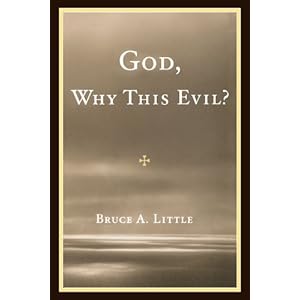
Why Does God Allow So Much Evil: My Thoughts on GOD, WHY THIS EVIL? byBruce Little


Any time spent observing our world quickly reveals that much evil takes place in our world, and much of it seems pointless. The question is, why does God allow all this evil? For several hundred years, many people have relied on something called the greater good theodicy. A theodicy is an explanation of why God allows evil. The greater good theodicy states that God only allows an evil to occur if he can bring about a greater good from the evil. Under this theodicy, every act of evil serves a purpose in the sovereign plan of God. The greater good theodicy is meant to be comforting to people as they try to find the greater good for which God allowed any given evil to occur in their life or the life of someone they love. However, if God only allows an act of evil to occur to bring about a greater good, then logically the evil act itself was necessary in order to bring about the greater good. Unless God could have brought about the greater good without the evil act occurring and just doesn't, the greater good theodicy unintentionally makes God dependent upon evil in order to bring about something good. No orthodox Christian believes that God needs evil in order to bring about good. So the traditional greater good theodicy fails to account for why God would allow evil.

This is the point that Bruce Little makes in his book GOD, WHY THIS EVIL? Little explores the different formulations of the greater good theodicy throughout history and exposes the inherent weaknesses in each of them. He makes the compelling case that the greater good theodicy actually does more harm than good in explaining why God allows evil. For example, if God allows an evil act in order to bring about a greater good, then by trying to stop the evil act, are we not trying to impede a greater good that God is trying to bring about? And isn't God's command to actively fight evil a command to actually work against what God is trying to accomplish through the evil?

After exposing the weaknesses of the greater good theodicy, Little suggests a new theodicy to describe why God allows evil. Little calls this the Creation Order Theodicy. Little stands firm in the camp of libertarian freedom, to which I agree with him. Within the Creation Order Theodicy, man is free, but in his freedom he introduces evil into the world and commits evil acts. According to Little, God allows these evil acts not primarily so he can use them to bring about a greater good, but because he is honoring man's free will to choose evil acts. Of course, God does sometimes use evil to bring about something good. However, it's the attribution of it being a “greater” good that is the problem. How is that measured? If God only allows an evil act to occur that he can bring about a greater good from, what does that say about God's power and character? If the good is only greater as a result of the evil, then isn't the evil act both necessary and in some way good because it's necessary to bring about a greater good? If evil is necessary for good, then this logically makes God the author of evil. Could the all-powerful and sovereign God not bring about a “greater” good without the use of an evil act? It seems quite clear that he could. So the greater good theodicy doesn't give us a good or even biblical answer for why God allows evil.

The Creation Order Theodicy states that God created the world with certain parameters or boundaries, so that man is free to the extent that he doesn't impede what God is ultimately trying to accomplish in human history. In other words, God planned out the world in such a way that he knows exactly where he wants the story to end up, but he allows humanity to have a significant level of freedom to make genuine choices, including evil choices, and the parameters act as boundaries in which God sovereignly and infallibly protects his divine plan. So God can allow the horrible evil of Herod slaughtering the innocents of Bethlehem because that is Herod's choice, but he won't allow Jesus to be there among the innocents because Jesus must live to be the savior of the world. Obviously, this isn't much more comforting than the greater good theodicy because it means that God allows an evil, but for no purpose whatsoever other than protecting one man's freedom to choose. It should be noted that God hated the slaughter of the innocents more than us. But that causes us to ask why he didn't stop it. He obviously was active in protecting Jesus, but why not the other little boys?

The Creation Order Theodicy has its flaws, but I land squarely with Little on the negative implications of relying on the greater good theodicy. The Creation Order Theodicy, I think, is a step in the right direction, but it still leaves us with God allowing evil with no good explanation of why. Little believes that this world, from beginning to finish, is the “best possible world” because God only does his best. However, if this world with all of its history of disgusting and alarming levels of evil is the best possible world, then it means that God was compelled to make the broken world we live in. He had no choice otherwise. Little appeals to a theological concept called middle knowledge, which attributes to God a deliberation of all the actions every single potential person would take under any set of circumstances and taking this into account to select the world history he will actualize. Though there have been many compelling cases for middle knowledge, I'm not sold on the evidence that God actually possesses this. One of the assumptions Little rests on, along with middle knowledge, is that God could not create a world of genuinely free creatures that at least one person didn't choose to do evil. But I think God who is all-wise was perfectly capable of creating a world of free creatures that would not choose evil. But that's not the world God created, which leaves us with more questions. Why did God create a world where evil was possible?

People often turn to Romans 8:28 in support of the greater good theodicy, but Little rightly points out that this only accounts for the evil actions being worked out for good for Christians. It doesn't account for evil across the whole human spectrum.

I think Little does a great job of showing the inadequacy of greater good theodicies, and he makes an important contribution with his Creation Order Theodicy. When it comes to why God allows evil, I think God has structured the universe in such a way that free beings, demons and humans, make free choices that have serious negative effects in our world. God promises that someday the evil will be over. Until then, the Scriptures frequently call upon God's people to actively stand against evil.

That leaves us with just as important of a question as why God allows so much evil? Why do we allow so much evil?

GOD, WHY THIS EVIL? is an important book to explore the difficult questions surrounding the existence of evil in our world.

I received this book for free for review from Hamilton Books

Sunday, December 4, 2011

God is Innocent: A Review of If God, Why Evil? by Norman Geisler

People have always wrestled with the amount of evil that plagues our world, especially in light of the idea of a loving and perfect God governing the universe. If God is good, then why is there so much evil? Why doesn't he stop it? I've wrestled with these questions as much as anyone. The world is messy, and much of it seems so random sometimes. But if God is good, then there must be a reason evil exists that doesn't make God out to be the cause of it.

Norman Geisler explores these questions in his book IF GOD, WHY EVIL? The book is surprisingly short for a book that explores such a controversial topic, but it works as a concise treatment that anyone can understand. Geisler rightly points out that evil exists because God granted both the angels and human beings with genuine free will. Genuine free will meant that the possibility of choosing to reject God was very real, and unfortunately both Satan and Adam and Eve chose to exercise their freedom to reject God. The result has been a widespread and persistent evil that is still the result of human beings and demonic beings exercising a genuine free will toward evil. Of course, those from a compatibalist view of freedom will find Geisler's appeal to libertarian free will disatisfyjng.

Geisler uses logical arguments throughout the book. His writing is clear and easy to understand. It's a very quick read.

My only discomfort with the book was Geisler's appeal to a "greater good" theodicy, which is probably the most prevalent view of why God allows evil. Obviously God can and does bring good out of evil events that happen. However, does God actually need to allow the evil in order to bring about a "greater" good? Doesn't that imply that evil is necessary for good to happen? Of course, no one who appeals to the "greater good" theodicy believes that evil is necessary. I think the book would have been better had it wrestled with this particular area a little more.

Geisler also has a great chapter about the fate of people who don't hear the gospel. There's also a critique of the book THE SHACK at the end.

IF GOD, WHY EVIL? is a concise look at the problem of evil. There are probably better books out there that look at the problem of evil more in-depth, but this book is good for those who want an easy read on this difficult subject.

I received this book for free for review from Bethany House.

Why do you think God allows evil?