Wednesday, November 30, 2011

Redemptive History for Children: A Review of The Jesus Storybook Bible by Sally Lloyd-Jones


One of the most exciting things about being a parent is walking with my children through the journey of discovering Jesus. My children are still really young, but as my daughter sings "Jesus Loves Me," I'm moved by the thought that my wife and I get to help our three children meet and fall in love with Jesus. Our children also love to read, so we want these early years to be a time to cultivate their love for reading and discovery and exposing them to the story and message of Jesus. There are a lot of Bibles specifically for children on the market, but I'm convinced there is no better children's Bible than THE JESUS STORYBOOK BIBLE by Sally Lloyd-Jones.

THE JESUS STORYBOOK BIBLE reads like an epic story about a hero who comes to rescue the people he loves. Lloyd-Jones tells the stories beautifully and profoundly illustrates how in the Bible every story whispers Jesus' name. She does an incredible job of showing how the Bible and all of human history is really one cohesive story about Jesus. Each of the stories include some very visually appealing full-color illustrations by an artist named Jago. My daughter is two, and she loves the illustrations especially.

I'd also have to say that I'm an adult, and I love THE JESUS STORYBOOK BIBLE. It's a great overview of the Bible, and it will serve as an excellent introduction to the real Bible for my children when they're old enough to engage with it.

Parents and children both will love THE JESUS STORYBOOK BIBLE, and preschool and children's ministries would be missing taking s great opportunity to get a copy of it into the hands of every child in their church.

I received this book for free for review from Zondervan.

If you've read THE JESUS STORYBOOK BIBLE, what is your favorite thing about it?

Monday, November 21, 2011

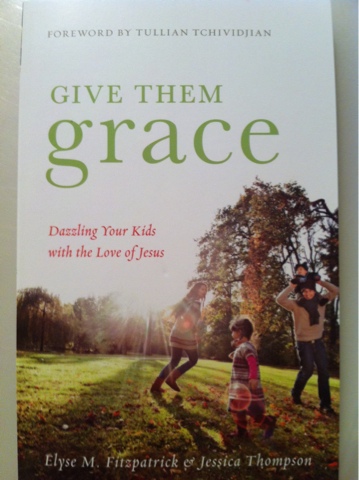
One Take on Christian Parenting: A Review of Give Them Grace by Elyse Fitzpatrick & Jessica Thompson


As Christian parents, my wife and I want nothing more than to raise our children to know and love Jesus. That's why I was excited to read GIVE THEM GRACE by Elyse Fitzgerald and her daughter Jessica Thompson. The book's goal is to present a model of parenting that is distinctly Christian.

Essentially, the book is about exposing your children to the incredible grace of Jesus contained in the gospel every opportunity you can, but especially during times of correction. Clearly communicating the gospel to your children is something I would never argue with. My children need Jesus to redeem their hearts because the betrayals they will undoubtedly commit in life are the source of separation from the God who loves them and made them to pursue only him. So I want to create spaces for them to encounter Jesus on a daily basis.

I wanted to like GIVE THEM GRACE because of its premise, but I found myself frustrated by the view of God that it presented throughout its pages. The authors take a very deterministic perspective of God, which I expected, but not perhaps to the extent that I discovered. Christian parents want to raise their children to be faithful Christ followers, but the authors assert that God alone changes our children, so parents shouldn't rely on anything they do as parents to change their children. While this places us firmly dependent on God, I couldn't get past that the proposed model of parenting, when followed to its logical conclusion, means that if God alone can change your children and your children aren't changing, it's because God has decided he doesn't want to change your children. The authors, who are trying to provide hope in God's provision, actually reduce hope because if God doesn't change your child, there's nothing you can do to change it. You, as a parent, end up wielding zero influence over your children under the proposed model and its underlying assumptions. In fact, in one particularly frustrating chapter, the authors state that sometimes God glorifies himself through your children's sin and rebellion. So you can relax knowing that, though your children are living lives you would have never dreamed for them, God is still glorifying himself. Again, not very comforting, and, though I don't have time to elaborate on it here, not very biblical. Under the proposed parenting model, I'm surprised that I haven't read or heard someone ask the question, "Why parent at all?" After all, God's going to work in your children's heart whether you do anything or not.

Another thing I found disappointing about the book was the stance that parents are to use the law to "crush" their children and make them see their desperate need for Christ. It seemed like an unhealthy focus on refusing to commend your children for any good thing they do because their depravity prevents them from doing anything good. If they have done anything good, it is only because God has worked in their heart to do the good thing. I got the impression from this book that I am to never tell my daughter that she's done a good job at something because that would be encouraging her to rely on herself rather than Jesus. The goal is to help your children fall in love with Jesus, and the way to do that is to essentially preach a sermon about your child's wickedness and Christ's goodness every time they do something that needs corrected. The problem is that the examples seemed to be belittling to a child or any human being, for that matter, and I couldn't see how taking this approach wouldn't cause a child to feel extremely resentful toward Jesus. Obviously, that's not what the authors were trying to communicate, but that's the way it came across at least to me.

What I did like about the book was the chapter on teaching our children media discernment based on the "one good story" of the gospel. The authors also make a clear case for the gospel and why we need it. I also appreciated their discussion about the different categories of training we engage in with our children.

I would suggest that anyone who decides to read this book to be cautious about viewing God as deterministic. I believe God calls parents to exercise godly influence on our children because it makes a genuine difference. GIVE THEM GRACE is correct in that our children desperately need the gospel to transform them and that God is the one who changes them. However, parents are called to cultivate their children's hearts to be receptive to God's working in their hearts. The book didn't do a good job of communicating that.

GIVE THEM GRACE had some thought-provoking points, and for that reason I would encourage parents to read it and process what it has to say.

I received this book for free for review from Crossway Books

What things do you do to mesmerize your children with the grace of God?

Sunday, November 20, 2011

Belonging: Thoughts on Church Membership

I've been reading WHY CHURCH MATTERS by Joshua Harris, which reminded me of the following I wrote almost a year ago...

Hebrews 13:17 tells believers to “Obey your leaders and submit to them,” but how do you decide who your leaders are? 1 Peter 5:2 tells church leaders to “shepherd the flock that is among you,” but how do church leaders decide who they're supposed to shepherd?

The New Testament never clearly describes what we today understand as church membership, but it’s clearly implied. Peter told the elders “shepherd the flock that is among you.” They aren’t to shepherd every Christian they ever come across. Peter assumes that the elders know exactly who they are responsible for and who they will have to give an account to God about. The elders know who they are responsible for because they know exactly what people have committed themselves to their leadership. To fulfill their responsibility, the elders of a church must be a part of a church that has a clear membership list of people he is responsible to provide spiritual leadership for.

Peter tells the believers to shepherd the flock that is among them. God doesn’t envision Christians submitting to the leadership of one church on a Sunday morning one week, then another church on Wednesday night of that week, then another church the next Sunday morning. God calls us to commit ourselves to one body of believers and the leadership of that body of believers. If you’re a member of this church, the leaders of this church are responsible for you. If a believer is a member of one church, but they’re also regularly attending another church, that believer is making it difficult for the leadership of their church to be obedient in watching over their soul if they’re not fully committed to that church alone. This doesn’t mean that God gets angry at you if you visit another church with a friend every once in awhile. It simply means that you are committed to your church and not another.

Spiritual leaders care for the spiritual health of the members they are responsible for. They have to give an account to God for how well they’ve done this. Obeying and submitting to leaders means that you live lives that honor God, and if the leader is a genuine God-appointed leader, how to do that will be reflected in his teaching. Your leaders help you to understand what God is trying to communicate to you about your life. They don’t dictate God’s will to you, but they help you to understand how to hear and communicate with God yourself. Obeying and submitting also means that you understand and devote yourself to the vision God has given the leader of your church.

In Ephesians 4:16 Paul says that a church can’t grow the way it is supposed to if each member isn’t working properly. Every church member is important and serves a role in their church that the church suffers for if that member doesn’t fulfill their role. Church members cannot be only halfway committed to their church because both they and the church suffer if they do.

Although the New Testament never outlines the concept of church membership, the whole of the New Testament assumes that believers will commit themselves to one body of believers and exercise their gifts there. God has placed spiritual leaders over specific churches so that people will submit to the leadership of that church.

What's a great church you're committed to?

Loving What Jesus Loves: A Review of Why Church Matters by Joshua Harris


The church as Jesus envisioned it and as the New Testament describes it was to be a place where people in love with Jesus came together and shared their lives with one another as a committed family. The church wasn't boring. The church wasn't a place to insist on personal preferences. The church was a place where believers selflessly loved one another and helped to cultivate each other's hearts to experience more and more the love and transforming power of Jesus. The writers of the New Testament understood the church as vital to their spiritual growth.

Today, however, believers often see the church as a highly encouraged, but optional part of their Christian life. The church, for most people, seems very boring, overrun with church politics, and rarely seen as a source of spiritual encouragement. Who really needs the church when it's full of hypocrites? Why can't I just settle for Jesus without the church?

Joshua Harris, in his book WHY CHURCH MATTERS, calls Christians to reconsider their perspective of the church. Using Scripture as his basis, Harris shows us that Christ loves the church and gave his life for it. Christians are called to love what Jesus loves, which includes the church. Harris elaborates on the biblical basis that commitment to a local church is not only expected, but vital to our spiritual journey. He encourages believers to abandon church "dating" and commit to a local church.

Harris also gives list of ten qualities to look for in a church:
1. God's Word is faithfully taught
2. Sound doctrine matters
3. The gospel is cherished and clearly proclaimed
4. Committed to reaching non-Christians with the gospel
5. The leaders are characterized by humility and integrity
6. The people strive to live by God's Word
7. I can find and cultivate godly relationships there
8. The members are challenged to serve
9. The church is willing to kick me out
10. With enthusiasm and faith, I'm willing to join this church "as is"

WHY CHURCH MATTERS is a timely message for Christians about falling in love with the church and belonging to a faith community.

I received this book for free for review from Waterbrook Multnomah through Blogging for Books

What emotions come up when you think about the church?

Friday, November 18, 2011

A Review of Against Calvinism by Roger Olson


Many of the writers, theologians, and pastors I follow most are Calvinists. Though I don't agree with their views of human freedom, the nature of God's sovereignty, how election works, the intent of the atonement, the location of faith in relation to regeneration, and probably a host of other things, I've learned much about Christ from men like Matt Chandler, John Piper, Michael Horton, and many others. We don't have to agree about how salvation works to agree that the message of Christ needs to be spread deep and wide, and I can tell these men love Christ deeply. All that to say, in reviewing Roger Olson's newest book AGAINST CALVINISM, I can affirm the intent of most Calvinists to paint a picture of God that is genuinely loving toward humanity, but, with Roger Olson, I agree that Calvinism, when consistently applied and followed to its logical conclusions, does more harm to the reputation of God than good. Since this is merely a review of AGAINST CALVINISM, I won't have the space to go into all the reasons why, but I'll be more than happy to interact in the comments.

Roger Olson is a Classical Arminian, and though I share more beliefs concerning soteriology with Olson than Horton, I don't agree enough with Arminianism enough to call myself an Arminian. However, one of the first things that I loved about this book was that it wasn't written as a defense of Classical Arminianism, but instead merely as a critique of the most controversial and biblically questionable points of Calvinism.

Some of the high points of the book:
• Olson points out that Reformed theology and Calvinism are not synonymous. In fact, it's possible to be Reformed and not hold to the five points of Calvinism. Olson describes those who are Reformed but not Calvinist as "revisionist Reformed."

• While most Calvinists adhere to a singular election where God merely passes over the non-elect, Olson shows how singular predestination actually entails double predestination.

• Olson makes a clear distinction between what Calvinism logically leads to and what Calvinists actually teach.

• Calvinism's divine determinism and compatibalist version of human freedom logically lead to God being the author of evil. After all, if Adam followed his strongest desire to eat of the tree, who gave him the desire if he was created good?

• Olson quotes quite a few Reformed theologians throughout history that have also objected on the points he is objecting to. The book is clearly well researched from all sides of the debate.

• Olson points out that Calvinism's teaching about unconditional election doesn't work because if God's choice has nothing to do with the people he chooses to save but upon his good pleasure, it's hard to get away from the decision being merely arbitrary. After all, God created everyone. He had a reason for saving the ones he saves and rejecting the ones he doesn't, but if it had nothing to do with anything within the creatures themselves, saying it was based on his good pleasure doesn't solve the problem. What gives God pleasure to save some and reject others if they're all equal in his mind since he bases his choice on nothing in them? Nothing sets them apart. So, logically, we're left with a choice that was made at random in the Calvinist system.

• Olson's criticism of the atonement providing common grace to the non-elect, though not for salvation. This view of the atonement reveals God's grace to the non-elect as useless where grace really counts. Olson refers to this as God giving the non-elect a little bit of heaven to get them to hell.

That's just a sampling of the things I resonated with in the book. Olson clearly strives to critique Calvinism not to start a fight, but to defend God against what he believes to be a false representation. Michael Horton's foreword at the beginning also reveals the graciousness Calvinists and non-Calvinists can extend toward one another as they both wrestle with the nature of what God has revealed about himself in Scripture.

There wasn't much about the book I disagreed with, though I have many thoughts on the subject that could have been touched on or developed more. I don't see how Romans 9, for example, could be just about corporate election and not individual election when Paul states at the beginning of the chapter that he's distraught over his people not being saved.

As with most books I've read critiquing five point Calvinism, it probably won't convince everyone who reads it to abandon Calvinism. But it will help those wrestling with why they don't agree with Calvinism. As another defense against Calvinism, I'd also recommend reading SALVATION AND SOVEREIGNTY by Kenneth Keathley. Both books, as well as Horton's FOR CALVINISM should be read with a highlighter and pen in hand.

Above all, in the midst of disagreement between Calvinists and non-Calvinists, it's important to be at peace with everyone, as Paul said.

I received this book for free for review from Zondervan.

What are your thoughts on the divine sovereignty/human freedom debate?

Wednesday, November 16, 2011

When Too Late Isn't Too Late

Imagine a young girl sitting in a hospital bed slowly succumbing to a terminal disease for which there is only one cure. This girl is greatly loved by a hero who is the only one who can rescue her from the disease. As she lies in bed, her family knowing that she's nearing the end, she waits for her hero to come with the cure. Her family just knows he'll show up in time. He's never let them down. They even sent him a message to let him know how desperately he was needed, and he had the means to be there at a moment's notice. But the girl's father sits staring at his watch. He hasn't heard anything back, and his daughter is getting weaker by the moment.

It's Not Too Late

The hero finally shows up with the cure...three days after the little girl's funeral.

That's not exactly the hero story we would expect. The little girl is beyond the point of being helped. What do you do when the hero turns out not to be a hero after all? How do we handle when the hero shows up too late for us?

Wouldn't it be great if too late wasn't actually too late?

Two thousand years ago, Jesus seemed to show up too late on several occasions. His friend Lazarus was dying. When he was warned that Lazarus was nearing the end, he stayed another two days where he was. Lazarus had been in a tomb four days when Jesus finally showed up. Had Jesus come sooner, he could have done something, but Lazarus in the tomb was beyond helping. It was too late.

We know what it's like for too late to creep upon us. The time for hope is gone.

But, for Jesus, too late wasn't too late. He didn't have to follow the rules of nature. Death could be undone. Tragedy could be undone. Sure enough, Jesus calls Lazarus out of the tomb, alive and well. Too late wasn't too late, after all.

The same thing happened with a man named Jairus' daughter. She died. It was too late, and Jairus was devastated. But Jesus undid the tragedy after it was too late. Which means that it wasn't actually too late.

Life hits pretty hard sometimes, and we're often desperate for God to come through for us. But many of us are probably familiar with the experience of too late arriving before God does. So we cling to the God for whom too late isn't too late, and we await our hero to come through. Refuse to lose hope when everything looks grim.

"By faith Abraham, when he was tested, offered up Isaac, and he who had received the promises was in the act of offering up his only son, of whom it was said, "Through Isaac shall your offspring be named." He considered that God was able even to raise him from the dead, from which, figuratively speaking, he did receive him back." - Hebrews 11:17-19

When have you experienced a time when God showed up too late?

Photo Credit: Fleur-Ange Lamothe on Flickr

Churches in Disconnect: A Review of You Lost Me by David Kinnaman


Barna Group president David Kinnaman has written one of the most important and most well-thought-out books on what the church of Jesus Christ is supposed to look like. In YOU LOST ME, Kinnaman writes as a reaearcher who cares deeply about the church and the 60-80% of young people who are leaving it as soon as high school is over.

Based on Barna Group's research, Kinnaman takes us on a moving journey through the reasons 18 to 29 year olds who are disconnecting from involvement in the church. What Kinnaman reveals are people who have questions and who often care very deeply about their faith in God and want to be a part of a faith community, but they're not finding it. Instead, they're finding churches that espouse a faith that seems disconnected from the rest of their lives. These churches seem ill-equipped to connect a generation of young people that are part of a culture that is vastly different than cultures of the past. What has always worked isn't working anymore, and the church is losing many people who are vital to the Body and Bride of Christ and its impact in the world.

Kinnaman labels three different types of young people who are disconnecting from the church-Nomads, Prodigals, and Exiles. The chapters describing these people are very thought-provoking and will probably resonate with church practitioners in the 18 to 29 age range. I know it did for me.

Kinnaman walks us through the six reasons 18 to 29 year olds are disconnecting. They are finding the church to be:
Overprotective-"The church is seen as a creativity killer where risk taking and being involved in culture are anathema."
Shallow-"Easy platitudes, proof texting, and formulaic slogans have anesthetized many young adults, leaving them with no idea of the gravity and power of following Christ."
Antiscience-"[S]cience seems accessible in a way that the church does not; science appears to welcome questions and skepticism, while matters of faith seem impenetrable."
Repressive-"Sexuality creates deep challenges for the faith development of young people."
Exclusive-"[Young adults] have been shaped by a culture that esteems open-mindedness, tolerance, and acceptance."
Doubtless-"[Young adults] do not feel safe admitting that faith doesn't always make sense."

Kinnaman describes six turns that these reasons provide opportunities for churches to reconnect young adults to the church:
• Discernment
• Apprenticeship
• Stewardship
• Relational
• Embrace
• Doing

Kinnaman's suggested solutions for young adult connection are biblical and provide hope for a church that is deeply impactful to the world around it.

Kinnaman closes out the book with some insightful thoughts on generational connections in the church and a return to the concept of vocation. Finally, the book includes ideas for connection from some great thinkers, both well-known and not so well-known.

YOU LOST ME is a vital book for church leaders, youth ministry and young adult leaders and parents of teens and young adults.

I received this book for free for review from Baker Books

What ideas do you have to keep young adults connected to the church?